
Welcome to The Wilf Ward Family Trust News and Blogs page!

Join us on an exciting journey as we share heart-warming stories, valuable insights, and updates about the Trust’s meaningful work. At the core of our mission is enhancing the lives of individuals with learning disabilities, autism, and other complex needs, driven by collaboration, compassion, and understanding.

Stay informed about our latest news, celebrate the achievements of the incredible individuals we support, and gain insights into the impactful contributions of our dedicated team members.

Together, let’s inspire, connect, and make a positive difference.
Rooted In Yorkshire - Shaped by people.For 40 years, The Wilf Ward Family Trust has been shaped by people, relationships and communities across Yorkshire. And while social care has changed significantly over the past four decades, one thing has remained constant: the importance of people.
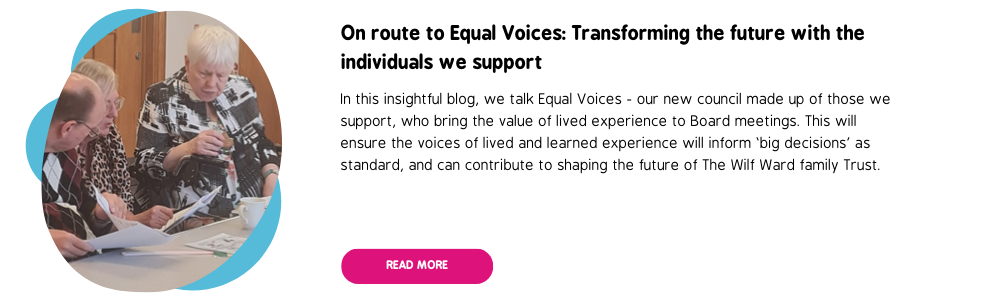
Image shows a close-up of a white rose of Yorkshire flag.
The Small Moments We Remember.When people look back on meaningful moments in life, it is often not the biggest occasions they remember first. It is the ordinary moments. Because they remind us what it feels like to feel connected, valued and part of something.
Image shows two people stood by the railings overlooking a beach, looking out to sea. They are both dressed in warm coats and there is a walker next to one of them.
William Bradley Day - read the latest blog by Denis Chadwick on his day out in Market Weighton on ‘Giant Bradley Day’.William Bradley was born in Market Weighton in North Yorkshire in around the 1800's or so. As a child he started to have an incredible growth spurt. By the time he grew up, he stood at a height of 7ft 9 inches tall and he weighed 27 stone.
Denis is sat in his wheelchair throwing his arms outwards, he is smiling. Behind him is the wooden statue of William Bradley, with a banner that reads ‘Giant Bradley Day’.


Blog by Fliss Simpkin - Beyond Words: The Invisible Language of Connection Communication happens every single day—usually without us even realising it. We use it to share ideas, send messages, and express emotions. But when communication is only recognised in traditional ways, the individuals we support can be misunderstood, overlooked, or spoken for instead of listened to.